Page 1 — City of Athens, Tennessee
City of Athens, Tennessee
Procurement Policies and Procedures
Reviewed by City Council on June 9, 2025
Adopted by City Council on June 17, 2025
Effective July 1, 2025
Source page 1 visual reference
Effective July 1, 2025. Adopted June 17, 2025.
Reviewed by City Council on June 9, 2025
Adopted by City Council on June 17, 2025
Effective July 1, 2025
[Source page is blank.]
                                  Table of Contents


          Section 1.0 General                                          Page

          1.01      Basis and Purpose ……………………...……………………………………................…1
          1.02      Applicability ………………………………...……………………………………..…......1
          1.03      Procurement Authority ……………………………………………………………………1
          1.04      Budget Authority ……………………………………...……………………………..…...1

          Section 2.0 Procurement Thresholds and Payment Methods

          2.01      Purchases Under 10,000………………………….…………………………………….….2
          2.02      Purchases of $10,000 to $25,000 …………………………………………...…………….2
          2.03      Purchases of $25,000 and Over (Requires Competitive Bidding and Public Advertising)…………….2
          2.04      Prohibition of Subdividing Purchases to Avoid Competitive Bidding …………….…..…2
          2.05      Inspection of Purchases for Quality Assurance……………………………...……………2
          2.06      Multi-year Contracts ………………………………………………………………...……3
          2.07      Tax Exempt Forms ……………………………………………………………………......3
          2.08      Use of City Credit Cards …………………………………………………………...……..3
          2.09      Use of Vendor Accounts...…………………………………………………………...……3

          Section 3.0 Procurement Methods when Competitive Bidding and Public Advertising are
                    Required
          3.01      Competitive Sealed Bids ………………………………………………..……...…………4
          3.02      Competitive Sealed Proposals ……………………………………………………….....…4
          3.03      Contracts for Professional Services …………………………………………………...….5
          3.04      Request for Proposals (RFP) for Construction Management Services …….………...…...5
          3.05      Required Insurances and Documents for Competitive Solicitations ……………………..6
          3.06      Competitive Bidding Addenda ………………………………………………..……...…..6
          3.07      Electronic Bidding ………………………………………………………………………..7
          3.08      Electronic Signatures ………………………………………………………………...…...7
          3.09      Minor Informalaties and Irregularities in Submitted Sealed Bids and Proposals …...……7
          3.10      Mistakes in Submitted Sealed Bids and Proposals …………………………………...…..7
          3.11      Failure of Awarded Bidder to Execute Contract …………………………………...……..7
          3.12      Failure to Receive Any Competitive Sealed Bids or Proposals …………………………..7
          3.13      Solicitation Delay or Cancellation …………………………………………………....…..8
          3.14      Bid Protests …………………………………………………………………………...…..8
          3.15      Notice to Proceed ……………………………………………………………………...….8

          Section 4.0 Procurement Methods when Competitive Bidding and Public Advertising are Not
                    Required

          4.01      Request for Qualifications (RFQ) for Legal Services, Fiscal Agent, Financial Advisor,
                    Insurance Producers, and Other Professional Services ……………………………...……9
          4.02      Recurring Purchases ………………………………………………………………...…….9
          4.03      Sole Source Items …………………………………………………………………….......9
          4.04      Emergency Purchases ………………………………………………………………...…..9
          4.05      Real Property Purchases ……………………………………………………….………..10
          4.06      Secondhand Purchases ……………………………………………………..........………10
          4.07      Purchases from Public Auctions …………………………………………………...…....10


i Table of Contents
Section 4.0 Procurement Methods when Competitive Bidding and Public Advertising Page
are Not Required
4.08 Purchases from Tennessee Rehabilitative Initiative in Corrections (TRICOR) .………..10
4.09 State Purchasing for the City …………………………………………………...……….10
4.10 City Purchases from State and Federal Contracts …………………………..…………..10
4.11 City Purchases from Local Sources …………………………………………...………...11
4.12 Cooperative Purchasing Agreements with Other Local Governments in the State…...…11
4.13 Cooperative Purchasing Agreements with Other Local Governments Outside the State
and the Federal Government ……………………………………………………...……..11
4.14 Cooperative Purchasing Using Master Agreements …………………………...………..11
4.15 Purchases from Other Local Government Contracts and Price Agreements ……...…….11
4.16 Purchases Made for Other Local Governments …………………………………...…….12
4.17 Interlocal Contracts for Performance of Services …………………………….…...…….12
4.18 Purchases Using Awarded Grant Funds …………………………………………...……12
Section 5.0 Construction Projects
5.01 Required Use of Architects, Engineers, and Landscape Architects ……………………..13
5.02 Required Bonds for Construction Projects ……………………………………...………13
5.03 Required Insurances and Documents for Construction Projects ……………………..….13
5.04 Required Contractor Licenses ……………………………………………………...……14
5.05 Notice to Proceed …………………………………………………………………...…...14
5.06 Contract Change Orders …………………………………………………………...…….14
5.07 Liquidated Damages ………………………………………………………………..…...14
5.08 Final Acceptance of Construction Projects ………………………………………..….…14
Section 6.0 Acquisition and Disposal of Real or Personal Property
6.01 Personal Property Purchases from Other Governmental Agencies ……………...……...15
6.02 Transfer/Conveyance of Real or Personal Property to Another Public Agency…………15
6.03 Sell/Convey of Real Property and Existing Buildings to Not-for-Profit Corporations….15
6.04 Transfer of Fire Department Assets to Volunteer Fire Departments …………...……….15
6.05 Disposal of Real or Personal Property by Private Negotiations and Sale………………..15
6.06 Disposal of Real or Personal Surplus Property Generally ………………………...…….16
6.07 Trade-in of Vehicles and Equipment ………………………………………………...….16
Section 7.0 Standardization of Vehicles, Equipment, Technology, Traffic Signal Equipment, and
Maintenance Agreements …………………………………………………………...…16
Section 8.0 Purchase of Travel ………………………..……………………………………………17
Section 9.0 Procurement Ethics
9.01 Conflicts of Interest …………………………………………………………………...…17
9.02 Prohibition of City Officials and Employees from Purchasing Surplus Property …...….18
9.03 No Contact/No Advocacy During Bid Solicitation ……………………………….....….18
9.04 Vendor Loyalty Programs …………………………………………………………...…..18
9.05 Acceptance of Social Courtesies …………………………………………………...……18
9.06 Visits to Vendors ………………………………………………………………...………18
ii Table of Contents
Page
Section 10.0 Records Retention of Procurement Documents ……….……………………………..19
Section 11.0 Miscellaneous Provisions
11.01 Buy America Act ………………………………………………………………………..19
11.02 Boycott of Israel Statement ……………………………………………………….……..19
11.03 Iran Divestment Act ……………………………………………………………….…….19
11.04 Vending Machines ………………………………………………………………………19
Section 12.0 Violation of Policies ………………………………………………………………….....19
Section 13.0 Severability and Conformity
13.01 Severability ……………………………………………………………………...………20
13.02 Conformity ………………………………………………………………………………20
Section 14.0 Official Adoption ……………………………………………………………………….20
iii[City seal: CITY OF ATHENS; EST. 1822; CITY HALL; THE FRIENDLY CITY; TENNESSEE. No other text.]

These procurement policies and procedures are established under the authority of the City Charter, Article IX (City Manager) Section 2(h), Article XVII (Budget and Appropriations) Section 4, City Code Title 1, Chapter 4 (City Manager) 1-90 to 1-93, and Tennessee Code Annotated (TCA) 6-56-301 et seq., known as the Municipal Purchasing Law of 1983. These local charter and code provisions along with state laws provide the legal foundation to guide city departments in planning for and acquiring goods and services needed by the city. The purpose of this policy is to ensure that goods and services are purchased at competitive prices with high quality and standardization, where appropriate, from reliable vendors in an economical, efficient, and transparent manner, thereby maximizing the value of public resources. This policy aims to formalize, simplify, clarify and improve the purchasing and contracting process as well as encourage effective, fair, open, legal, and impartial competition to the maximum extent possible among vendors.
This policy applies uniformly to all departments of the City of Athens. This applicability ensures that all city purchasing activities are consistent, legally compliant, and conducted under a common set of guidelines.
The city will maintain a centralized procurement process where all city departments’ purchasing activities are coordinated and tracked by the Finance Department and its Purchasing Division for effective and efficient accounting. The City Manager, as established by city charter, has the ultimate responsibility for these Council approved purchasing policies and procedures. The City Manager delegates the day-to-day administration and interpretation of these policies and procedures to the city’s Finance Director and the full-time Purchasing Assistant.
Budget authority is a crucial aspect of the procurement process. In accordance with TCA 6-56-303, no procurement of any goods or services shall occur unless a budget appropriation is available in the current year’s Council approved budget. Each department head or their designee has the responsibility of reviewing their approved budget to ensure funds are available prior to starting the procurement process. Department heads or their designee can move funds from one line-item to another within their approved budget with the assistance of the Finance Director but cannot exceed the approved departmental budget total. If an additional budget appropriation is needed that exceeds the approved departmental budget total, a budget amendment may be requested from the City Council in a public meeting.
1
This section delineates the thresholds for procurement activities as mandated by City Code Title 1, Chapter
4 (City Manager) 1-90 to 1-93 and TCA 12-3-1212. Various exemptions apply including, but not limited to, professional services, sole source items, emergency purchases, real property purchases, secondhand purchases, public auction purchases, purchases from state and federal contracts, and purchases from certain cooperative purchasing agreements.
Purchases that are expected to be under $10,000 must obtain a purchase order through the city’s electronic purchase order system. The best possible price and quality shall be sought. Any resulting contract or agreement shall be developed by the Purchasing Assistant with a copy to the Finance Department and City Manager’s Office.
Purchases, leases, or lease-purchase agreements that are expected to exceed 40% of and up to the state maximum ($25,000) must obtain at least three competitive written quotes via written quotations, email, or facsimile without competitive bidding or public advertising as referenced by TCA 12-3-1212, 6-56-305, and City Code 1-92. A written no-bid quote from a vendor is an acceptable quote. To obtain comparable quotes, a standardized written form distributed to each vendor is preferable. The lowest and most responsive quote that meets specifications will receive the award. Any resulting contract or agreement shall be developed by the Purchasing Assistant with a copy to the Finance Department and City Manager’s Office.
Purchases, leases, or lease-purchase agreements that are expected to exceed $25,000 shall require competitive bidding and public advertising. Written bid or proposal specifications and invitation to bid documents are to be prepared and publicly advertised in a newspaper of general circulation not less than 14 days prior to the opening of the bids. Other advertisement locations include the city’s website, direct solicitations to known vendors, Vendor Registry website, and Demand Star website. All responses are to be opened in a public bid opening. See Section 3 for the procurement methods and details when competitive bidding and public advertising are required.
The bids and any resulting contract or agreement with the selected vendor shall be reviewed by the City Attorney and then considered for approval by the City Council in a public meeting. However, in accordance with the City Charter, Article IX, (City Manager) Section 2(h), if any contract is not awarded to the lowest bidder, the reason for such action shall be given in writing to the City Council.
No purchases shall be subdivided to avoid the requirements of competitive bidding.
Upon delivery of purchased equipment, supplies, materials, documents, vehicles, and services, it is incumbent on the department head or designee to inspect the equipment, supplies, materials, documents, vehicles, and services to determine if the delivered items met all established specifications and are in good order prior to payment. If not, the department head or designee shall coordinate with the Finance Department to ensure the invoice is not processed for payment and the damaged item sent back to the vendor unpaid.
2
According to TCA 12-3-305, contracts for certain materials, supplies, and services may be extended by the Purchasing Assistant for multiple years, not to exceed five years and without any changes in price, if the extension is in the city’s best interest and the materials, supplies, and services are being provided in a satisfactory manner.
Most city purchases are exempt from state and local taxes. It is the responsibility of the purchaser to ensure sales taxes are not paid on city purchases. The Finance Department has tax exempt forms and the city’s FEIN number. Any sales taxes paid by the city on purchases that should have been tax exempt is the responsibility of the employee to pay.
Purchases made through the city’s credit cards should be infrequent and used primarily for city business and travel related expenses such as reserving hotel rooms, paying membership dues, renting equipment, and paying for certain Internet purchases. Normal purchasing procedures shall apply when using the city’s credit cards. The credit card is simply a payment method. Under no circumstances shall the city’s credit card be used for personal purchases, even to be reimbursed later by the employee.
Purchases made using established vendor accounts at such local businesses as Lowes, Food City, Ingles, Tractor Supply, Auto Zone, and Harbor Freight are allowed as long as a receipt is returned to the Finance Department with a budget code and a legible employee signature.
3
Below are the various methods to purchase goods and services when the cost is expected to exceed $25,000 and competitive bidding and public advertising are required. When using these purchasing methods, written bid or proposal specifications and invitation to bid documents shall be prepared and publicly advertised in a newspaper of general circulation not less than 14 days prior to the opening of the bids. Other advertisement locations include the city’s website, direct solicitations to known vendors, Vendor Registry website, and Demand Star website. All responses shall be opened in a public bid opening.
Competitive sealed bids are used when needed goods and services are standard, routine, and common, their quantities can be specified exactly such as vehicles, equipment, office equipment, and materials like salt, paving materials, or computer equipment. In this method, price is the most important criteria. The bid shall be awarded to the lowest, responsive, and responsible bidder whose bid meets the specifications and requirements as established in the bid document and is determined to be in the best interest of the city. Negotiations are not allowed with this method of procurement. The bids and any resulting contract or agreement with the selected vendor shall be reviewed by the City Attorney and then considered for approval by the City Council in a public meeting. However, in accordance with the City Charter, Article IX, (City Manager) Section 2(h), if any contract is not awarded to the lowest bidder, the reason for such action shall be given in writing to the City Council.
When competitive sealed bids are determined not practical nor advantageous to the city, TCA 12-3-1207 authorized cities to use competitive sealed proposals to purchase goods and services when qualifications, experience, and competence are more important than price alone. Competitive sealed proposals are used when there is more than one solution to a purchasing issue or when there is no readily identifiable solution to a purchasing problem and this method of purchasing will assist in choosing the best solution.
Competitive sealed proposal documents must state the relative importance of price and all other evaluation factors and provide information regarding interviews, presentations, demonstrations, and discussions, either oral or in writing or both, that may be conducted to clarify and fully understand the proposal with one or more responsible respondents who submitted proposals. All respondents must be accorded fair and equal treatment with respect to an opportunity for an interview, presentation, demonstration, discussion, or revisions. The Purchasing Assistant and any other city personnel shall not disclose any information derived from proposals submitted by the respondents.
Submitted competitive sealed proposals must be publicly opened in a manner that avoids disclosure of the contents to competing respondents during later negotiations. The submitted proposals and all related materials must be available for public inspection after the intent to award a contract to a particular respondent is announced. Revisions may be permitted after submission and before the intent to award to a particular respondent is announced to obtain the best and final offers. The award shall be made to the responsible respondent whose proposal the City Council determines is the most advantageous to the city, taking into consideration price and all evaluation factors contained in the competitive sealed proposal document. No other factors may be used in the evaluation. The Purchasing Assistant shall place in the contract file a statement containing the basis on which the award was made. The resulting contract or agreement with the selected vendor shall be reviewed by the City Attorney and then considered for approval by the City Council in a public meeting.
4
Contracts for professional services are used when procuring services such as engineering services, architectural services, construction management services, surveying services, or energy related services that have as their purpose the reduction of energy costs in public facilities. TCA 12-4-107 and 12-4-110 authorizes cities to obtain qualifications and experience information from firms licensed in the state. Once this information is obtained, the city’s Purchasing Assistant and/or a selection committee will review the submitted information, interview the top-ranked firms as needed and deemed appropriate to discuss and evaluate their qualifications, and select the most qualified firm to provide the requested services based on qualifications, experience, and competence, not solely on cost. Once a qualified firm has been selected, the Purchasing Assistant will negotiate a proposed contract including scope of work, schedule, price, and other terms. If a contract cannot be agreed upon with the selected firm, the next qualified firm(s) will be given the opportunity to negotiate a contract until a satisfactory contract is reached. Once a proposed contract has been agreed upon, the City Attorney will review the contract and the City Council will then consider the contract for approval in a public meeting.
If the city has a satisfactory existing working relationship with a professional services firm, wants to continue that working relationship, and the firm has the technical competencies to perform the requested work, the above process is not required to be performed.
For projects funded in whole or in part by the U.S. Department of Transportation, Federal Highway Administration, or Tennessee Department of Transportation, the city shall follow the consultant selection policy as contained in the Local Government Guidelines Form 1-2 as adopted by the city.
Furthermore, the selected professional service firm shall provide, in addition to other required insurances, professional liability insurance covering the performance of their contract with policy limits of not less than $1,000,000 per claim and $3,000,000 in the aggregate.
For construction projects or additions to existing city buildings, the city may elect to use a licensed architect, or a licensed engineer, or a construction management service to oversee those projects. TCA 12-4-107 authorizes cities to procure construction management services through a written request for proposal (RFP) process that is publicly advertised. The RFP process would state the services needed and the factors used for evaluating the proposals. The evaluation factors typically include the qualifications of assigned personnel, experience on similar projects, fees, costs, and any other additional factors deemed relevant by the city. Once a proposed contract has been agreed upon, the City Attorney will review the contract and the City Council will then consider the contract for approval in a public meeting to the best qualified and responsive responder.
A construction manager is prohibited from conducting actual construction work on a project he is overseeing the planning, bidding, or construction except in instances where bids have been solicited twice and no bids submitted where a good faith effort was made and a price has been agreed upon by the city. The city may perform work on a construction project with its own employees and may include the oversight of the work by a construction manager. However, all actual construction work shall be by competitive sealed bids opened at a public bid opening and names of the contractors and their bid amount announced.
5
Furthermore, in accordance with TCA 62-6-129, the selected construction management firm shall provide at the time of proposal submittal a bid bond equal to 10% of the value of the services proposed and the value of the work to be managed or may at the time of contracting provide payment and performance bonds in amounts equal to the combined monetary value of the services of the construction manager and the value of the work to be so managed.
All bid or proposal specifications and documents for competitive solicitations shall require bidders or proposers to submit proof of the following insurances and documents that continue through the term of the contract:
At the Time of Bid Submittal (applies to all bidders)
• Unaltered, signed and fully executed bid form.
• Acknowledgement of all addendums, if any.
• Bid bond, if required, and in the amount as specified in the bid document.
• No Contact/No Advocacy Affidavit.
• Non-Collusion Affidavit.
At the Time of Bid Award (applies only to the awarded bidder)
• Workers’ Compensation Insurance at statutory limits.
• Commercial General Liability Insurance not less than $1,000,000 per occurrence and at least $3,000,000 in the aggregate naming the city as an additional insured.
• Automobile Liability Insurance not less than $1,000,000 per accident
• Employers’ Liability Insurance with policy limits of not less than $1,000,000 per accident.
• Pollution Liability Insurance if the contracted work involves the transportation, dissemination, use, or release of pollutants, with policy limits not less than $1,000,000 per claim.
• Any other insurance or document as required in the bid document.
• Drug Free Workplace certificate as required by TCA 50-9-113.
• E-Verify documentation as required by TCA 50-1-103.
• Certification that the bidder/proposer has not engaged in boycott of Israel as required by TCA 12-4- 119.
• Certification that the bidder/proposer has not engaged in investments with Iran as required by TCA 12- 12-101 to 113.
• Certification that the bidder/proposer is in compliance with Title VI of the Civil Rights Act of 1964, as amended, and all regulations promulgated thereunder.
• Valid business licenses from the City of Athens and McMinn County for projects over $100,000 as required by the Tennessee Department of Revenue.
As required by TCA 12-4-113, when conducting a competitive bid or proposal process, addenda shall not be issued within 48 hours of the established bid opening excluding weekends and holidays. If addenda are needed within the 48-hour period, the bid or proposal deadline shall be extended by the Purchasing Assistant to allow bidders to be aware of the changes and submit their bids accordingly.
6
According to TCA 12-4-116, bidding documents for competitive sealed bids, competitive sealed proposals, contracts for professional services, and RFPs for construction management services may be distributed to and received electronically from vendors as deemed appropriate by the Purchasing Assistant, but electronic distribution and responses shall not be required.
Electronic signatures on records and contracts are allowed in accordance with TCA 47-10-107.
Minor informalities and irregularities in submitted competitive sealed bids, sealed proposals, contracts for professional services, and RFP responses for construction management services that are merely a matter of form and not of substance and pertain to some immaterial defect from an exact bid or proposal requirement can be corrected or waived without being prejudicial to other bidders. Examples include if the bidder fails to submit the required number of copies of the bid, proposal, or qualifications stated in the bid document, bidder fails to sign the bid form when the bid is accompanied by other evidence that indicates the bidder’s intention of proceeding with the bid or proposal such as submittal of bonds, or when the bidder fails to acknowledge an amendment. If the Purchasing Assistant determines that the submitted bid or proposal contains these types of minor informalities and irregularities, the Purchasing Assistant shall give the bidder an opportunity to cure any deficiency or waive the deficiency. However, in no event shall the bidder be allowed to change the bid amounts or submit a bid bond if one was required in the bid document.
Upon submission of a written request to the Purchasing Assistant and prior to the bid opening, a bidder may withdraw his submitted competitive sealed bid, competitive sealed proposal, contracts for professional services, and RFP responses for construction management services, modify it, and resubmit it before the bid deadline if he believes mistakes in his bid or proposal were made. Any corrections must be performed in a transparent manner that does not confer any unfair advantage upon the bidder and in a way that does not prejudice the public’s interest. However, in no event shall the bidder be allowed to change the bid amounts after bids have been opened. In case of errors in the mathematics of the bid price, unit prices shall prevail.
If an awarded bidder fails to execute a contract or submit all required insurances and documents within 10 business days after receiving a Notice to Award from the city, the Purchasing Assistant shall have the authority and option to proceed with the second most responsive and responsible bidder without rebidding or having to go back to the City Council. If the second awarded bidder cannot or will not fulfill the conditions of the award, the product or service will be rebid.
In the event the city fails to receive any sealed bids or proposals from a competitive solicitation, the Purchasing Assistant is authorized to either rebid the product or service or enter into negotiations with a qualified vendor to obtain the needed product or service. The resulting contract or agreement with the selected vendor shall be reviewed by the City Attorney and then considered for approval by the City Council in a public meeting. 7
The Purchasing Assistant may delay or cancel a competitive bid or proposal solicitation in whole or in part prior to the public opening when there are clear and compelling reasons to do so when in the city’s best interest.
As outlined in TCA 12-3-514, any bidder or proposer who believes they have been aggrieved during the bidding or proposal process can submit a written protest via hard copy or electronically to the city’s Purchasing Assistant within 7 calendar days after the Notice of Award or intent to award. Any protest received after the 7-day period shall not be considered. All protests shall be accompanied by a protest bond from a surety or insurance company authorized to do business in the state of Tennessee, or a letter of credit, or cash in the amount of 5% of the lowest bid or cost proposal that was evaluated. The protest bond serves as a guarantee of the validity of the protest. Upon determination by the Purchasing Assistant of the protest, the protest bond will be returned to the protesting party if the protest is upheld or cashed by the city and retained as damages if the protest is denied.
Once the competitive bid or proposal process has been concluded and an award has been made, the Purchasing Assistant will issue a Notice to Proceed to the selected vendor only after obtaining a fully executed contract and all required proof of insurances and documents as contained in the bid or proposal specifications. No work on city property shall commence without these fully executed documents.
8
This section delineates purchases that do not require competitive bidding or public advertising. The maximum expenditure that can be made under city charter rules without City Council approval is $25,000.
When procuring legal, fiscal agent, financial advisor, insurance producers, or other professional services from groups of high ethical standards, TCA 12-3-1209 and 12-3-103 require the basis of award be of recognized competency and integrity as opposed to competitive solicitation. The resulting contract or agreement shall be in writing, specifying the services to be rendered, cost, and covered expenses, reviewed by the City Attorney, and then considered for approval by the City Council in a public meeting.
In addition, in accordance with TCA 29-20-407, competitive bidding and public advertising are not required when purchasing insurance through a plan authorized and approved by any organization of governmental entities representing cities and counties.
Purchases of goods and services used regularly by the city such as utility services, waste disposal services, security monitoring services, maintenance agreements, advertising, and the like shall be exempt from competitive bidding and public advertising and purchased from established and reliable sources at the best possible price. Any resulting contract or agreement shall be developed by the Purchasing Assistant with a copy to the Finance Department and City Manager’s Office
If a good or service has a single source of supply or is a unique proprietary product as evidenced by a letter from the vendor, competitive bidding and public advertising are not required but normal purchasing procedures apply. When sole source items are purchased, TCA 6-56-304 (2) requires a record of each sole source item or proprietary product be made by the corresponding department head and Purchasing Assistant. The record shall specify the amount paid, the items purchased, and from what company the purchase was made.
Purchases or leases of any supplies, materials, or equipment for immediate delivery in actual emergencies arising from unforeseen causes including delays by contractors, delays in transportation, and unanticipated volume of work do not require competitive bidding or public advertising. When emergency items are purchased, TCA 6-56-304 (3) requires a record of each emergency purchase be made by the corresponding department head and Purchasing Assistant. The record shall specify the amount paid, the items purchased, from what company the purchase was made, and the nature of the emergency. A report on all emergency purchases with the above information shall be made as soon as possible to City Council and City Manager.
9
Purchases, leases, or lease-purchase agreements for real property do not require competitive bidding or public advertising in accordance with TCA 6-56-304(5). Before acquiring real property for public purposes, the City Council shall authorize the acquisition and staff shall obtain an appraisal of the property to determine fair market value, a Phase I environmental assessment to identify potential environmental contamination on the property, and a hazardous material survey, if applicable, to determine the level of existing contamination (i.e. asbestos or lead based paint) on the property or buildings. However, if the property to be acquired is a minor portion of a larger parcel for such needs as sidewalks, greenways, or road improvements, or the purchase price is equal to or less than the appraised value or cost of the appraisal, the above requirements are not necessary.
Purchases, leases, or lease-purchases of secondhand goods, equipment, materials, supplies, or commodities from any federal, state, or local government do not require competitive bidding or public advertising in accordance with TCA 6-56-304(6). Furthermore, TCA 12-3-1202 authorizes purchases of used or secondhand articles from private individuals or entities without competitive bidding and public advertising as long as the city documents the general range of value of the purchased item through a listing in a nationally recognized publication or through an appraisal by a licensed appraiser and the price is not more than 5% higher than the highest value of the documented range.
As authorized by TCA 12-2-421, the city may purchase new or secondhand articles, equipment, materials, supplies, and commodities from publicly advertised auctions without competitive bidding and public advertising. If items are purchased at a publicly advertised auction, the Purchasing Assistant shall prepare a report for the City Council regarding the description of what was purchased, the auction where the items were purchased, the purchase price of the items, and the vendor of the items.
The city is required by TCA 41-22-119 to purchase all articles needed that are produced, repackaged, assembled, warehoused, or manufactured by inmates in the Tennessee Rehabilitative Initiative in Correction (TRICOR) program if the articles are certified pursuant to procedures approved by the procurement commission as being of satisfactory quality and reasonable in price and available. Purchases of certified articles from TRICOR are exempt from competitive bidding and public advertising.
As authorized by TCA 12-3-1201, the city may request the state’s central procurement office to purchase goods and services for the city. When the state purchases goods and services for the city, the state will use their purchasing terms, rules, and regulations and invoice the city for the cost of those services.
TCA 12-3-1201 allows the city to purchase goods and services from contracts or price agreements entered into by the state’s central procurement office without competitive bidding and public advertising. In addition, the city may purchase goods and services from federal General Service Administration contracts or other federal open purchase contracts directly from the federal agency or through the appropriate state agency at the stated price in the contract or lower. 10
TCA 12-3-1201 allows the city to purchase goods and services from local sources without competitive bidding and public advertising if: 1) the good or service is available for purchase under contracts or price agreements entered into by the state’s central procurement office, 2) the local price is the same or lower as the state’s contract pricing, and 3) the local product is of equal or better specifications that the state’s contract specifications.
TCA 12-3-1205 authorizes the city to participate in, sponsor, conduct, or administer a cooperative purchasing agreement for the procurement of any goods, supplies, services, equipment, or construction with one or more other local governments in the state in accordance with an agreement entered into between the participants.
TCA 12-3-1205 authorizes the city to participate in, sponsor, conduct, or administer a cooperative purchasing agreement for the procurement of any goods, supplies, services, or equipment that were procured in a manner that constitutes competitive bidding and were advertised, evaluated, and awarded by a governmental entity and made available for use by other governmental entities. The city may enter into an agreement with one or more governmental entities outside the state or with a federal agency to the extent the laws of the other state or the laws of the federal government allow joint purchasing. The city shall acquire and maintain documentation that the purchasing entity that procured the bid complied with its own purchasing requirements. Exceptions include the purchase of new or unused motor vehicles unless the motor vehicles are manufactured for a special purpose as specified in TCA 12-3-1208 including but not limited to school buses, buses with capacity exceeding 22 passengers used to provide public transportation, garbage trucks, fire trucks, ambulances, or new or unused construction equipment. Exceptions also include the purchase of construction, engineering, or architectural services or construction materials or fuel.
TCA 12-3-1205 and City Resolution 2020-32 authorizes the city to participate in master cooperative purchasing agreements to purchase goods and services from national cooperative purchasing alliances such as Sourcewell, Omnia, and Naspo. The city is required to acquire and maintain documentation that the purchasing entity with the master agreement complied with its own purchasing requirements.
TCA 12-3-1203 allows the city to purchase supplies, goods, equipment, and services under contracts or price agreements entered into by any other local government agency of the state without competitive bidding and public advertising. Exceptions include the purchase of new or unused motor vehicles unless the motor vehicles are manufactured for a special purpose as specified in TCA 12-3-1208 including but not limited to school buses, buses with capacity exceeding 22 passengers used to provide public transportation, garbage trucks, fire trucks, ambulances, or new or unused construction equipment. Exceptions also include the purchase of transportation infrastructure projects such as construction and improvements of streets, highways, bridges, tunnels, or any roadway related facility. When purchasing from other local government contracts, the city will handle payments, refunds, returns, and any other communications or requirements without involving the local government that originated the contract. The originating local government shall have no liability or responsibility for any purchases made by the city. 11
As authorized by TCA 12-3-1203, the city may purchase supplies, equipment, and services for other local government entities upon request. In doing so, the city will use their purchasing terms, rules, and regulations, and invoice the requesting local government for the direct and indirect cost of the purchase.
As authorized by TCA 12-9-108, the city may contract with one or more other public agencies to perform any governmental service, activity, or undertaking that the public agency is authorized to perform by law. Any resulting contract shall include the purpose, powers, rights, objectives, and responsibilities of each contracting party and be approved by all parties to the contract. Public agencies include other local governments (other cities, counties, school systems, development districts, and utilities districts), private incorporated fire departments not supported or partially supported by public funds, incorporated rescue squads not supported or partially supported by public funds, state agencies, federal agencies, or political subdivisions of another state.
When procurement of goods and services involves awarded grant funds, the city shall follow all mandatory grant requirements as stipulated in the language of the actual grant award. Nothing in these policies and procedures shall prevent the city from complying with the terms and conditions of any grant award, gift, donation, or bequest. Absent any specific grant award language, these procurement policies and procedures shall prevail.
12
This section delineates how the city should approach construction projects to comply with numerous state laws regulating construction projects.
As mandated by TCA 62-2-107, when performing construction or maintenance projects involving architecture, engineering, or landscape architecture services over $50,000 and the project alters the structural, mechanical, or electrical systems of the project, the city shall engage a state of Tennessee registered architect, engineer, or landscape architect as outlined in Section 3.03 to prepare plans, specifications, and cost estimates.
As required by TCA 12-4-207, construction, maintenance, or repair projects over $10,000 require a bond from the contractor to guarantee prompt payment of all taxes, licenses, assessments, contributions, penalties, and interest due to the state or city directly connected with the performance of the awarded contract.
As authorized by TCA 12-4-201 and 12-4-202, construction projects over $100,000 shall require:
• bid bond from all bidders in the amount of 10% of the bid amount collected at the time of bid submittal to guarantee the selected bidder will proceed with an awarded project. The bid bond will be returned to all bidders once the project is under contract with the awarded bidder. If the awarded bidder does not execute a contract with the city within ten business days after receiving a Notice of Award, the bid bond will be redeemed and the proceeds retained by the city and used to obtain another bidder or to rebid the project.
• performance bond from the awarded bidder in the amount of 100% of the contract price to guarantee the awarded bidder will complete the project.
• payment bond from the awarded bidder in the amount of 100% of the contract price to guarantee the awarded bidder will pay all subcontractors.
Such bond requirements shall be included in the bid document and bid advertisements. The bonds shall be written by a surety or insurance company listed on the U.S. Department of the Treasury financial management service list of approved bonding companies and licensed and authorized to do business in the state of Tennessee. Failure to obtain the required bonds will result in a Class C misdemeanor.
See Section 3.05 for required insurances and documents for construction projects.
13
As mandated by TCA 62-6-119, the city’s bid documents for construction projects shall contain information stating that it is necessary for bidders to be properly licensed at the time of bid submittal and to provide evidence of compliance at the time of bid submittal before the bid can be considered for award. The city’s bid documents shall require that the following information be written upon the envelope that contains the bid or provided within the electronic bid: the name, license number, expiration date, and license classification of the:
• contractor applying to bid for the prime contract.
• contractor applying to bid for the masonry contract where the total cost of materials and labor for the masonry portion of the construction project exceeds $100,000.
• contractor applying to bid for the electrical, plumbing, heating, ventilation, or air conditioning contracts where the portion of the construction project exceeds $25,000.
• Only one contractor in each classification shall be listed.
During the bid opening of a construction project, the names of all contractors listed on the submitted bid shall be read aloud and incorporated into the bid. Prior to awarding the bid, the Purchasing Assistant shall verify the accuracy, correctness, and completeness of the required information as listed above and, if any discrepancies are found in the spelling of names of bidders, transposition of license numbers, or other similar typographical error, may be corrected within 48 hours after the bid opening excluding weekends and state-recognized holidays. Failure to obtain the required licenses will result in a Class A misdemeanor.
See Section 3.15 regarding when to issue a Notice To Proceed for construction projects.
After a construction project has been awarded and commenced, city staff and the Purchasing Assistant may approve written changes to plans, specifications, cost, and scheduling up to the established contingency amount to keep the construction project progressing. Once the contingency amount has been exhausted, any changes from that point on or any changes that are materially different from the original scope of the project shall be first approved by the City Council in a public meeting as a formal change order. In the rare event an immediate change order is needed to avoid significant and expensive delays, the change order may be issued and retroactively approved by the City Council during their next meeting.
Each construction project’s bid documents, specifications, and contract shall contain an amount of not less than $250 per business day for liquidated damages when the established contract completion date is missed. Inclement weather days or unforeseen events outside the control of the contractor, as reviewed and determined by the city and the contractor, will be factored in the amount of liquidated damages.
Prior to final payment to the contractor and architect, the construction project shall be accepted in writing by the city. In addition, the contractor shall submit a fully executed contractor’s affidavit to the Purchasing Assistant proving all subcontractors have been paid in full.
14
This section delineates how the city can acquire and dispose of real and personal property to comply with numerous state laws that regulate these matters.
As authorized by TCA 12-2-420, the city may purchase, trade, or receive as a gift any used or surplus personal property from another governmental agency without competitive bidding and public advertising upon approval of the governing bodies involved in the transaction. Any transfer or purchase of surplus personal property from the state shall be retained by the city for one year unless disposal is approved by the state. In addition, TCA 12-2-407 states that transfers of motor vehicles from the state to the city shall be void and reverted to the state if the city does not transfer title to its name within seven days after the transaction.
TCA 12-9-110 authorizes the city to transfer/convey real or personal property to another public agency if the receiving public agency uses the property for a public purpose and each governing body that is a party to the contract authorizes such transfer. A declaration of the property as surplus property prior to the transfer/conveyance is not required. Furthermore, TCA 12-2-420 authorizes the city to sell, trade, gift, or barter any used or surplus personal property to another governmental agency upon the authorization of the City Council.
In accordance with TCA 12-2-302, the city may sell and convey title or lease, not to exceed 50 years, city- owned real property and existing buildings to not-for-profit corporations upon such terms and conditions that are in the best interest of the city.
As authorized by TCA 12-3-1206, the city, upon approval of the City Council, may transfer ownership of fire protection assets purchased through or with proceeds of federal, state, or local grants to volunteer fire departments that are registered as nonprofit organizations with the Tennessee Secretary of State’s Office.
As authorized by TCA 12-2-501, the city may dispose of city-owned real or personal property by private negotiations and sale when the real or personal property is: 1) significant for its architectural, archaeological, artistic, cultural, or historical associations, 2) significant for its natural, scenic, or open condition, 3) significant for its relationship to such properties, or 4) to be sold to a non-profit corporation or trust whose purpose includes preservation or conservation and a preservation or conservation agreement is placed in the deed conveying the city property to the non-profit corporation or trust detailing the use, disposal, or other restrictions of the property that will promote the preservation or conservation of the property including public access.
15
As needed, the City Council, during public meetings, may declare unneeded or obsolete city-owned vehicles, equipment, or real property as surplus city property and authorize city staff to dispose of those items though advertised sealed bids, advertised public auctions, electronic auctions such as Govdeals.com, use of a real estate agent, or donation/transfers to other entities as described in this section. All real property must be appraised by a certified appraiser or at least have a realistic estimated value from an authorized source to establish value prior to sale. The bid/auction shall specify a minimum bid amount. All sealed bids are to be advertised once a week for two weeks in the city’s legal organ, city’s website, and any other places deemed appropriate by the Purchasing Assistant.
The city may consider trading in existing city-owned vehicles and equipment when purchasing new vehicles and equipment to obtain a more competitive price. Trade-in options, where appropriate, will be a part of the bid documents and the resulting bid award with the trade-in vehicle/equipment and value will be approved by the City Council.
The city shall consider standardizing the purchases of vehicles, equipment, technology, traffic signal equipment, and maintenance agreements where it makes financial and economic sense for operational efficiency. Such items will only be competitively quoted among vendors providing the specific item or service using the established purchasing procedures. Examples include but not limited to:
Standardization of vehicles and equipment to minimize replacement parts, diagnostic equipment, repair services, and have knowledge of a single brand to make the repair of vehicles and equipment more efficient and economical than having many different parts, repair manuals, diagnostic equipment, and knowledge. To ensure all vehicle and equipment purchases will be compatible with the existing city inventory, all vehicle purchases shall be coordinated with the city’s Fleet Maintenance Foreman.
Standardization of computer equipment, infrastructure, and technology to ensure that any new or replacement computer parts are compatible with the city’s existing computer network. To ensure all technology purchases will be compatible with the existing city network, all technology purchases including hardware and software shall be coordinated with the city’s IT Director. Since cybersecurity is a vital part of any IT system and to avoid broadcasting the city’s specific IT hardware configurations and software specifications, if the city has a satisfactory existing working relationship with a trusted IT vendor and that vendor has the products, services, and expertise the city needs, the city can purchase IT equipment without competitive bidding and public advertising from those trusted vendors.
Standardization of traffic signal equipment such as signal controllers, detection equipment, and programming/operating software to ensure that any new or replacement parts are compatible with existing parts.
Standardization of maintenance agreements such as copier maintenance agreements to have only one vendor who knows and understands city equipment and personnel.
16
All travel purchases including transportation and lodging shall be in accordance with the travel policies contained within the city’s Employee Handbook.
In accordance with TCA 12-4-101 and 6-54-107, any officer, director, other person, or elected official whose duty is to vote for, let out, or supervise any work or contract for the city, shall not have any direct or controlling financial interest in any city contract. If they have an indirect financial interest in a city contract, this fact must be publicly acknowledged. This shall not apply to the City Council voting on general items such as the annual budget, appropriation resolutions, tax rate resolutions, or amendments unless the vote is on a specific budget or appropriation item in which the Councilmember has a direct or controlling financial interest.
If a city elected official has a conflict of interest in a matter to be voted upon by the City Council, that member may abstain for cause by announcing such to the presiding officer. The abstaining member shall not be counted for the purpose of determining a majority vote. If the member does not inform the City Council of a conflict of interest, the vote shall be void if challenged during the same meeting the vote was cast and prior to the transaction of any further business by the City Council.
In accordance with TCA 12-4-114, no public officer or city employee who is involved in making or administering a contract on behalf of the city may derive a direct benefit from the contract.
No city employee having official responsibility for a procurement transaction shall participate in that transaction on behalf of the city when the:
• city employee is employed by the bidder or proposer.
• city employee, employee spouse, or any member of the employee’s immediate family holds a position with the bidder or proposer such as an officer, director, trustee, partner, or is employed in a capacity involving personal and substantial participation in the contract or owns or controls an interest in the contract more than 5%.
• city employee, employee spouse, or any member of the employee’s immediate family has a pecuniary interest arising from the contract.
• city employee, employee spouse, or any member of the employee’s immediate family is negotiating or has an arrangement concerning prospective employment with the bidder or proposer.
• Immediate family means spouse, dependent children or stepchildren, or relatives related by blood or marriage.
A public officer or city employee who will derive a direct benefit from a contract with the city but is not involved in making or administering the contract shall not attempt to influence any other person who is involved in making or administering the contract.
No public officer or city employee may solicit or receive any gift, reward, or promise of reward in exchange for recommending, influencing, or attempting to influence the award of a contract by the city.
In accordance with TCA 12-4-102, the penalty for violating the above financial interest in city contracts shall be forfeiture of all pay and compensation, dismissed from office, and be ineligible for rehire for ten years.
17
According to TCA 6-54-125, city officials and employees are prohibited from purchasing any city-owned real or personal property that has been declared as surplus property by the city during the official’s term of office or the employee’s term of employment and for six months thereafter. Exceptions are if the surplus property is sold by public auction.
To ensure the integrity of the competitive bid process and guarantee all prospective bidders receive the same information, companies and/or individuals submitting bids as well as those persons representing such bidders may not contact, lobby, or advocate to any member of the city including but not limited to the City Council, City Manager, or any other city staff member during the entire bid solicitation period from posting of the bid to awarding the bid. Any and all contact regarding bids shall go through the Purchasing Assistant. Any unauthorized contact may cause the disqualification of the bidder/proposer and their submitted bid/proposal.
Any benefits from vendor loyalty programs shall always benefit the city and not the individual employee or department.
An official or employee may not accept, directly or indirectly, any money, gift, gratuity or other consideration or favor of any kind from anyone in exchange for recommending, influencing, or attempting to influence the award of a contract by the city. Specific exceptions and further guidance on the ethical standards of accepting gifts and gratuities can be found in the Code of Ethics policy outlined in the Employee Handbook.
If elected officials or city employees need to visit a vendor’s plant, distribution center, or office for technical or business reasons, the cost should be paid by the city unless contractually covered by the vendor.
18
The city shall manage purchasing records including but not limited to bids, proposals, contracts, notes from bid openings, purchase orders, requisitions, and street construction contracts and associated bonds in accordance with TCA 10-7-702, City Resolution 2020-28, and the Records Retention Manual as prepared by the Tennessee Municipal Advisory Service (MTAS).
The city, in accordance with TCA 54-5-135, shall not purchase any materials such as asphalt products, rock, aggregate, sealers, and oils used for highway or roadway construction, resurfacing, or maintenance from any foreign government or company wholly owned and controlled by a foreign government, regardless of the location of the company, or from any agency of the foreign government or company. The Buy America Act does not apply if materials are not produced by American companies in sufficient and reasonably available quantities, or are of unsatisfactory quality, or if the American materials increase the overall project cost by 5% more than the overall project cost using materials produced by a foreign government owned company.
In accordance with TCA 12-4-119, the city shall not enter into contracts to acquire or dispose of services, supplies, information technology, or construction unless the contract includes a written certification that the company is not currently engaged in or will not, for the duration of the contract, a boycott of Israel. For this state law to apply, the contract must be over $250,000 in potential value or the contractor must have over 10 employees. This certification shall be submitted only by the awarded bidder.
As mandated by TCA 12-12-101 through 12-12-113, the city is prohibited from awarding a contract over $1,000 with a person(s) who engages in investment activities with Iran. Every submitted bid or proposal response must contain a statement by the bidder as follows: “by submission of this bid, the bidder and each person signing on behalf of the bidder certifies, and in the case of a joint bid each party thereto certifies as to its own organization, under penalty of perjury, that to the best of its knowledge and belief that each bidder is not on the list created pursuant to 12-12-106.” This certification shall be submitted only by the awarded bidder.
If the city wants to install vending machines on city property, the city shall first determine if a blind individual, who meets the requirements of the state’s business enterprise program for the blind and has been trained and licensed by the state to operate such a vending facility, is interested in operating the vending machines to give them the greatest possible opportunity to become self-supporting. Furthermore, the state shall be given the right of first refusal to operate the vending facility if an individual that is capable can be found to operate the vending facility. See TCA 71-4-501 through 503 for more details.
Department heads shall not request nor the Purchasing Assistant process any purchases that are in violation of these policies. The city shall not be responsible for any purchases or payments made outside these City Council approved procurement policies. If violations occur, disciplinary action may occur.
19
In the event that any provision of this policy conflicts with applicable laws such as the Tennessee State Code Annotated, Athens City Code, or the Athens City Charter, such provision shall be deemed invalid and unenforceable. In such cases, all remaining provisions of this policy shall remain in full force and effect.
This policy shall be deemed automatically amended, without further action by any party, to the extent necessary to comply with applicable laws, regulations, or binding policies issued by higher authorities. In the event any provision of this policy is inconsistent with such governing requirements, the remaining provisions shall remain in full force and effect.
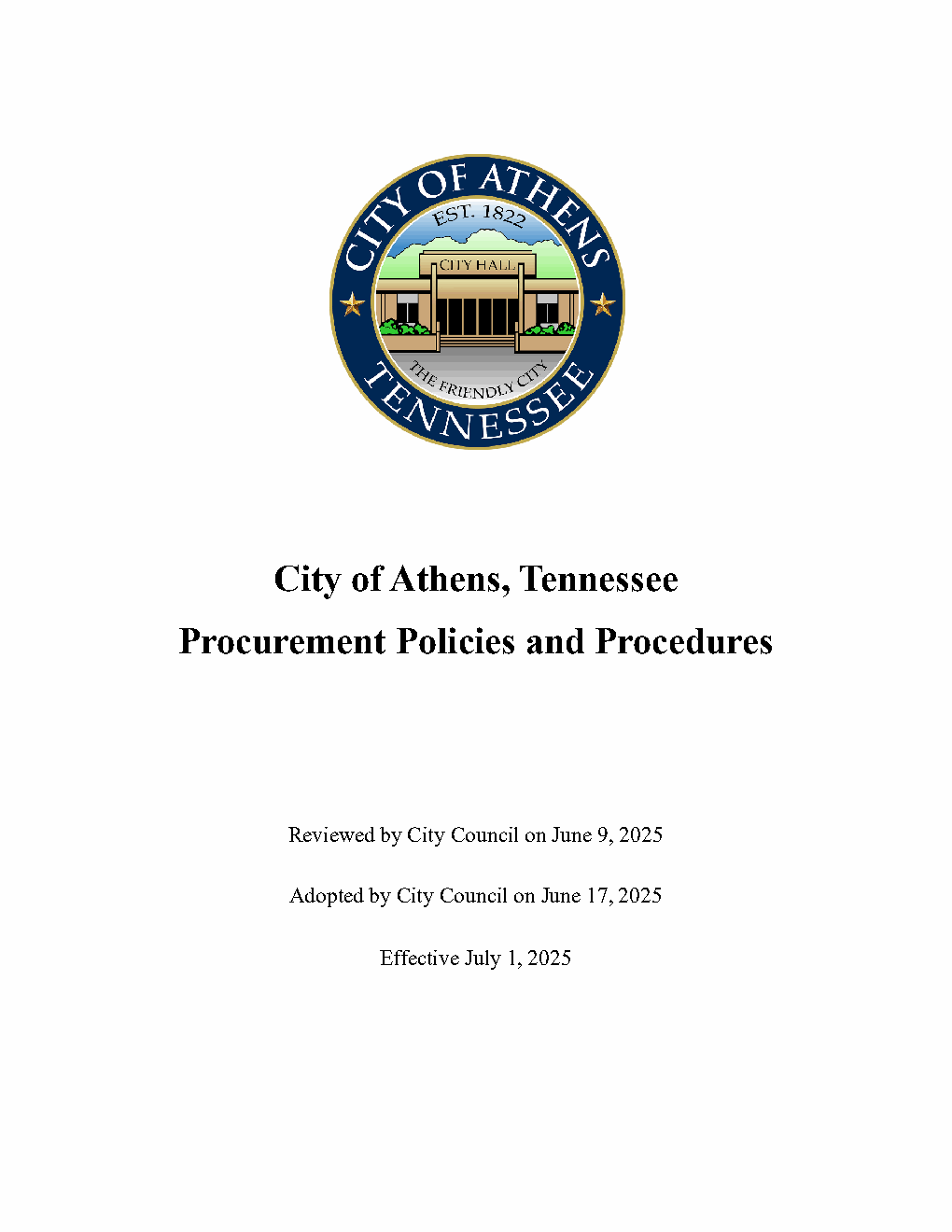
These procurement policies and procedures shall be effective on July 1, 2025 and may be amended from time to time by the City Council at a public meeting by appropriate amendment.
So approved this 17th day of June, 2025.
LARRY EATON, Mayor
RANDALL DOWLING, City Manager
APPROVED AS TO FORM
CHRISTOPHER M. CALDWELL, City Attorney
20
[The approval sentence and printed signature labels above were transcribed from the page image because the PDF text layer is garbled. Three handwritten signatures appear; see the source image below.]